ChatGPT
 Perplexity AI
 Claude
A strong administrative cover letter sample can be the quickest way to understand what hiring managers actually want to see, and what makes them stop skimming and start reading.
In this guide, you’ll get practical examples, real samples, writing tips, and professional cover letter templates you can customize in minutes. Whether you’re applying for an entry-level admin role or you’ve been running office operations for years, you’ll find a format that fits.


 See more examples like these
Keep reading to learn:
- How to analyze and learn from real administrative cover letter samples
- What formatting mistakes make admin cover letters harder to read
- How to write a clean administrative cover letter header
- Why a headline can boost your first impression instantly
- How to choose the right greeting (and what to do when you can’t find a name)
- How to introduce yourself without sounding generic
- Which administrative skills are worth highlighting first
- How to use action verbs without making the letter sound robotic
- How to end your administrative cover letter in a confident way
- The most common cover letter mistakes (and how to avoid them)
- Why your cover letter should match your resume visually
- Average salary and job outlook in administrative roles
- Where to find the best resources for job-seeking admin professionals
Still looking for a job? Our thorough and detailed cover letter and resume articles or career tools will help you get hired fast.
Office assistant cover letter example


Why does this cover letter example work?
- It clearly shows motivation and context for applying: Right from the start, the writer explains why they’re interested in the job and what specifically about the company attracts them, mentioning a desire to work in an international environment and grow language competencies. That’s far stronger than a generic “I want this job because I need work.” It gives the hiring manager a reason to care about the candidate’s goals.
- It highlights relevant experience and adaptability: Instead of just listing duties, the letter shows that the candidate has worked in multiple departments (Sales, Logistics, Reception) during an apprenticeship and has performed various administrative tasks. This variety demonstrates adaptability, which is an important trait for office roles where responsibilities frequently shift.
- It balances soft and hard skills: The letter mentions organizational strengths, comfort with routine tasks, ability to learn new systems, and enjoyment of both people and numbers. This mix tells the reader the writer can handle processes and people interactions - the two major pillars of administrative success.
- It uses a personable but professional tone: The writing feels human (not robotic) while staying professional. It doesn’t overuse buzzwords but still showcases reliability (“responsible,” “team player,” “prioritise my work assignments”), which aligns well with what admin hiring managers seek.
What could be improved?
- Include specific results to strengthen the impact: The letter describes tasks and responsibilities, but it doesn’t tie them to measurable results. For example, details like “reduced scheduling conflicts by X%,” “improved filing accuracy,” or “handled X office requests weekly” would anchor experience to outcomes, making the applicant’s contribution more tangible.
- Tailor more to the company’s mission or challenges: While the letter explains why the candidate likes the company’s international aspect, it could be even stronger by referencing something specific about Weathernews’ goals, clients, or operations - showing the applicant has researched and connected to the employer.
- Shorten some paragraphs for clarity: Some sentences are quite long and could be broken down to highlight key experiences more cleanly. Shorter paragraphs make it easier for recruiters to scan the letter (especially useful when reviewing many applications).
Assistant office manager cover letter example

Why does this cover letter example work?
- It opens with a clear tie to the job posting: Right from the first sentence, the candidate states their interest in the Assistant Office Manager role at the specific company and references where they found the job ad. This tells the reader the letter is intentional and tailored to this exact position, and that it's not just a generic copy-paste sent everywhere.
- It shows relevant experience and accountability: The body describes the applicant’s experience coordinating daily office operations, maintaining compliance with procedures, and managing a variety of administrative tasks. That aligns perfectly with what an assistant office manager is expected to do, and it signals reliability and multitasking ability, as both are core expectations for mid-level administrative roles.
- The candidate mentions specific tools and technical skills: Instead of vague wording like “comfortable with office software,” the cover letter lists proficiency with programs such as Zoho CRM, Bitrix24, and Hootsuite. That adds credibility and shows readiness to step into the role without extensive up-skilling.
- It has a professional closing with an invitation to discuss further: The ending doesn’t just say “thank you.” It clearly invites contact and provides multiple ways to reach out (phone and email), which increases the likelihood of follow-up communication.
What could be improved?
- Add measurable achievements to show real impact: The letter tells us what the applicant did (daily coordination, compliance, task management), but it doesn’t include any quantifiable outcomes such as “reduced turnaround times by X%” or “improved record accuracy by Y%.” Quantified examples would make the applicant’s contributions more concrete and memorable.
- Make the company fit even more specific: While the opening mentions the role and company, the letter could go a step further by connecting the applicant’s strengths to a specific business need or company goal (e.g., supporting growth, improving processes, boosting operational efficiency). That level of customization helps the reader see why this person, at this company.
- Break up the text into slightly shorter chunks: Some sentences are quite full, which can make the letter feel dense to quickly skimming hiring managers. Adding one or two more paragraph breaks, especially between greeting/introduction and first body point, would make it even easier to scan.
Service administrator cover letter example

Why does this cover letter example work?
- It starts with a strong and relevant introduction: The letter opens by clearly stating the candidate’s experience and the role they’re applying for. This immediately establishes context and level of expertise, which matters for a senior-admin position where clarity and confidence are expected. The reader instantly knows who the candidate is and why they’re relevant.
- It highlights leadership and problem-solving experience: Rather than just listing tasks, the cover letter includes examples of how the candidate oversaw operations, coordinated teams, and resolved service issues. These points underline the applicant’s ability to manage complex administrative workflows, and not just routine clerical work. That’s exactly the level of impact expected from a Service Administrator.
- It blends technical and soft skills effectively: The letter mentions both practical systems/process proficiency and people-management traits. For example, it references experience with regulatory compliance, client communications, and cross-department collaboration. This balance tells the hiring manager that the candidate is both organized and comfortable working with people, which is a crucial combination for senior admin roles.
- It shows professionalism without being overly verbose: The language feels polished, mature, and formal where needed, but not filled with unnecessary jargon. This matches well with executive-level administrative expectations, where the tone of communication often reflects the candidate’s reliability and attention to detail.
What could be improved?
- Add specific metrics or outcomes to quantify impact: Though the letter describes what the candidate managed, it doesn’t provide any measurable results, such as “reduced reporting errors by 30%” or “increased customer satisfaction scores by 15%.” These would help the reader quickly grasp how effective the candidate was in past roles.
- Connect achievements directly to employer needs: The letter could go one step further by tying accomplishments to industry-specific expectations or organizational goals of the hiring company. For example, if the role involves improving support turnaround times or enhancing service delivery, a reference to these goals would make the letter feel more tailored and strategic.
- Shorten or streamline longer sentences for readability: Some sentences contain several ideas at once. Breaking them into shorter, clearer statements would make the letter easier to skim, which is valuable when hiring managers review many applications quickly.
1. Format your administrative cover letter the right way
Formatting matters more in administrative roles than people admit. If the letter looks messy, recruiters might assume your work will be messy too, because admin jobs live and die by clarity. The goal isn’t to make it “pretty,” but readable in seconds. If you want a full breakdown of cover letter structure, you can also read our thorough guide on what is a cover letter and how to write one.
Here’s how to format an administrative cover letter so it looks professional and stays readable:
- Use a simple, readable font: Calibri, Arial, Helvetica, or Times New Roman are safe choices.
- Choose a practical font size: 11–12 pt for body text works best.
- Keep margins around 1 inch: It prevents the page from feeling cramped.
- Write short paragraphs: One idea per paragraph. Leave a blank line between paragraphs.
- Left-align your text: It’s the most standard and easiest to read.
- Keep it to one page: 4–6 short body paragraphs is usually perfect.
- Use bold sparingly: Only for headers, not for emphasis everywhere.
- Add white space intentionally: It makes the letter feel more professional instantly.
If formatting isn’t your thing, using a professional cover letter template or Kickresume’s AI Cover Letter Writer can save you time and avoid the most common layout mistakes.
Let your cover letter write itself — with AI!

2. Make a clean, complete administrative cover letter header
Even if you’re emailing your job application, your cover letter is still a formal document, therefore it should include a properly structured header part.
Admin candidates are often trusted with confidential info, documents, and internal comms, so basic accuracy matters. Your header is the first “quality check” a recruiter sees. If your details are incomplete or sloppy, it creates doubt immediately. Keep it simple, consistent, and easy to verify.
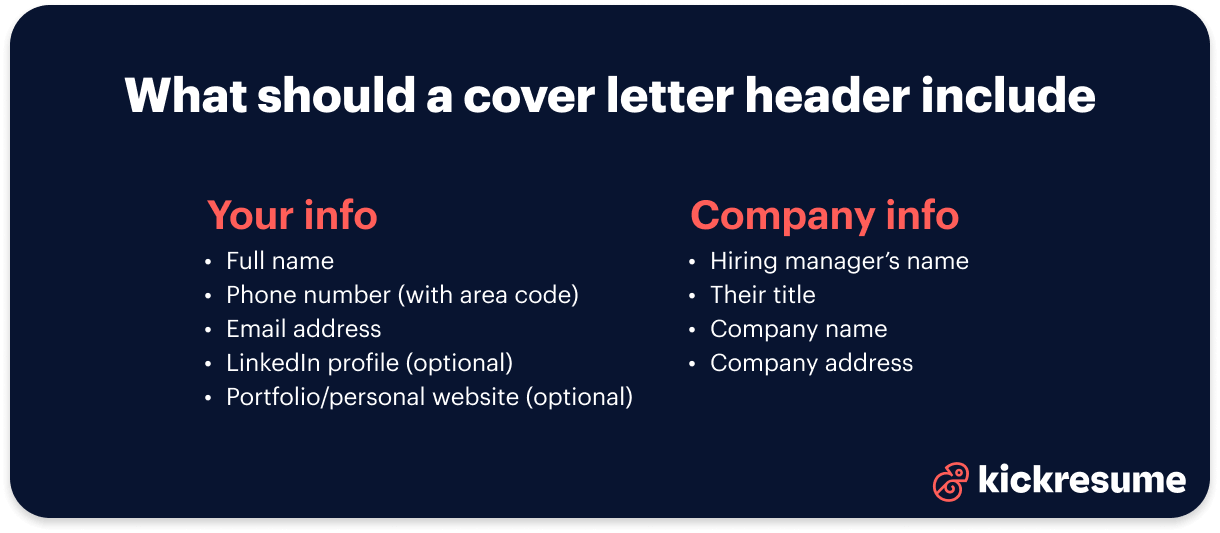
Include:
Your info (top left):
- Full name
- Phone number
- Professional email
- LinkedIn profile (optional, but useful if polished)
- Optional: portfolio/personal website (only if relevant)
Employer info (below your details):
- Hiring manager name (if you can find it)
- Their title
- Company name
- Company address (or at least city/state)
Bad example of a cover letter header
Anna K.
annak123@gmail.com
0911 22 33
To whom it may concern
Office
Why is this example not suitable? Because it's missing all the important aspects and the contact info is incomplete - the email looks unprofessional, the full name is missing, there’s no job title, no LinkedIn profile or portfolio, and there is no company address.
Now compare it to a clean, polished version:
Good example of a cover letter header
Anna Kovacs
(091) 122-3344
anna.kovacs@email.com | linkedin.com/in/annakovacs
Ms. Laura Bennett
Office Manager
Greenfield Consulting
123 Market Street
Bratislava, SK
A complete header makes your cover letter easier to file, forward, print, or review inside a hiring process.
3. Write an administrative cover letter headline that adds value
Most applicants skip the headline, and that’s exactly why it works when you use it.
Place a one-line headline under your header that summarizes who you are and what you bring.
Most cover letters start with a slow opening and waste valuable space. A headline fixes that by giving recruiters instant context before they commit to reading. Think of it like a one-line “label” that tells them what you do and what you’re strongest at.
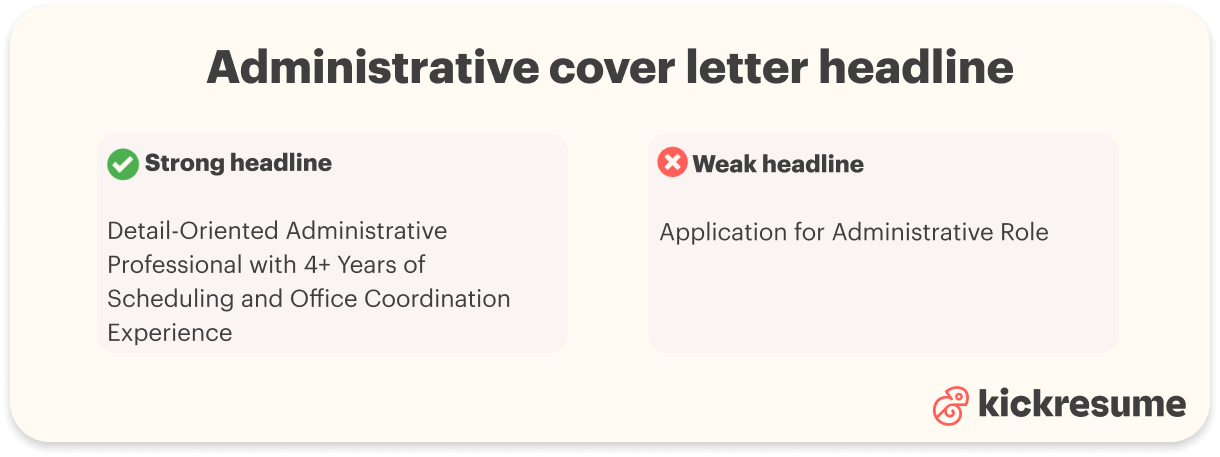
Bad administrative cover letter headline example
Application for Administrative Role
Why doesn't it work? Because it just repeats what the employer already knows and brings nothing new to the table.
Good administrative cover letter headline example
Detail-Oriented Administrative Professional with 4+ Years of Scheduling and Office Coordination Experience
If you’re just starting out or you have just entry-level experience, focus on your training and goals:
Good entry-level administrative cover letter headline example
Administrative Assistant Graduate with Hands-On Experience in Scheduling and Document Management
4. Personalize the greeting (it matters more than you think)
In administrative roles, details matter. And your greeting is one of the first details a hiring manager notices.
Many cover letters lose points right at the start by opening with generic lines like “To Whom It May Concern.” These greetings feel safe, but they can also feel impersonal and lazy. They suggest the letter could have been sent to any company, for any role.
When you address a real person, you signal something different – that you understand who you’re writing to, and that you chose this administrative role deliberately.
For office-based positions, where precision and professionalism are expected, this small step can quietly work in your favor.
How to identify the right person to address
You don’t need detective-level research. In most cases, one of these will do the trick:
- Job description: Some postings mention the hiring manager, department, or team responsible for the role.
- Company website: Look for office management, operations, or HR contacts on the Team or Careers pages.
- LinkedIn: Search the company and scan for titles like Office Manager, Operations Manager, HR Manager, or Administrative Lead.
- Direct inquiry: A short, polite email or call asking who reviews applications is perfectly acceptable and often appreciated.
Once you have a name, keep the greeting simple and professional.
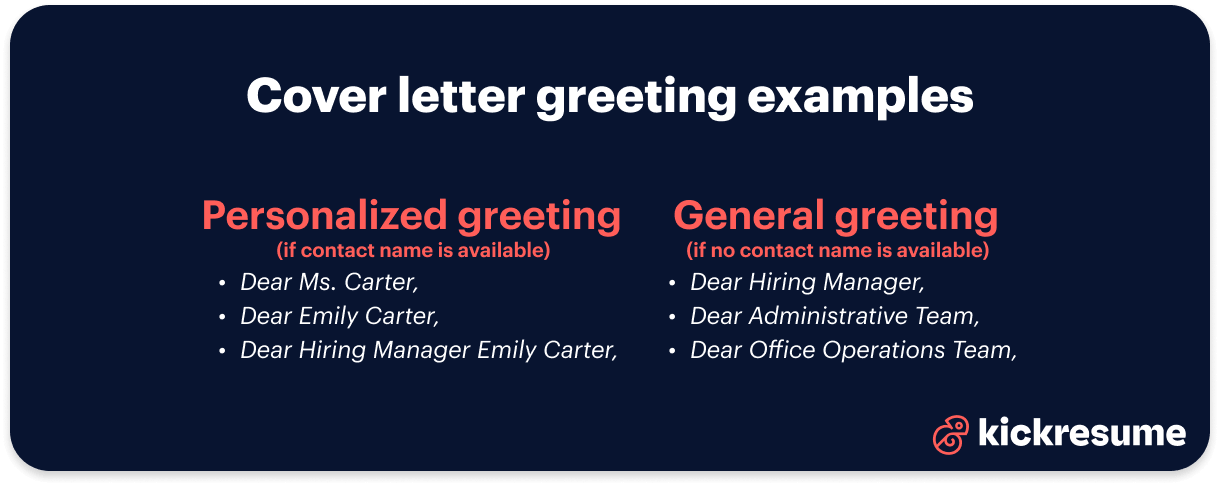
Examples of strong and personal cover letter greetings
-
Dear Ms. Carter,
-
Dear Emily Carter,
-
Dear Hiring Manager Emily Carter,
Each of these feels intentional and respectful without being overly formal.
When a name truly isn’t available
Sometimes, despite your best effort, no contact name surfaces. That’s not a deal-breaker, but the fallback still matters.
Instead of impersonal phrases, use greetings that acknowledge a real team or function:
General, but functional cover letter greetings
-
Dear Hiring Manager,
-
Dear Administrative Team,
-
Dear Office Operations Team,
These options still feel directed and thoughtful, rather than automated or outdated.
A well-chosen greeting won’t get you hired on its own. But in administrative positions, where organization, accuracy, and care are part of the job, it reinforces exactly the qualities employers are looking for before they’ve even read your first paragraph.
5. Make your introduction count from the very first sentence
The opening of your administrative cover letter sets the tone for everything that follows. And yet, this is where many applicants lose momentum immediately.
Forget the classic opener “I am writing to apply for…”. Hiring managers already know why you’re contacting them. What they want is clarity, and they want it fast. They want to understand who you are, what you bring to the table, and why they should keep reading.
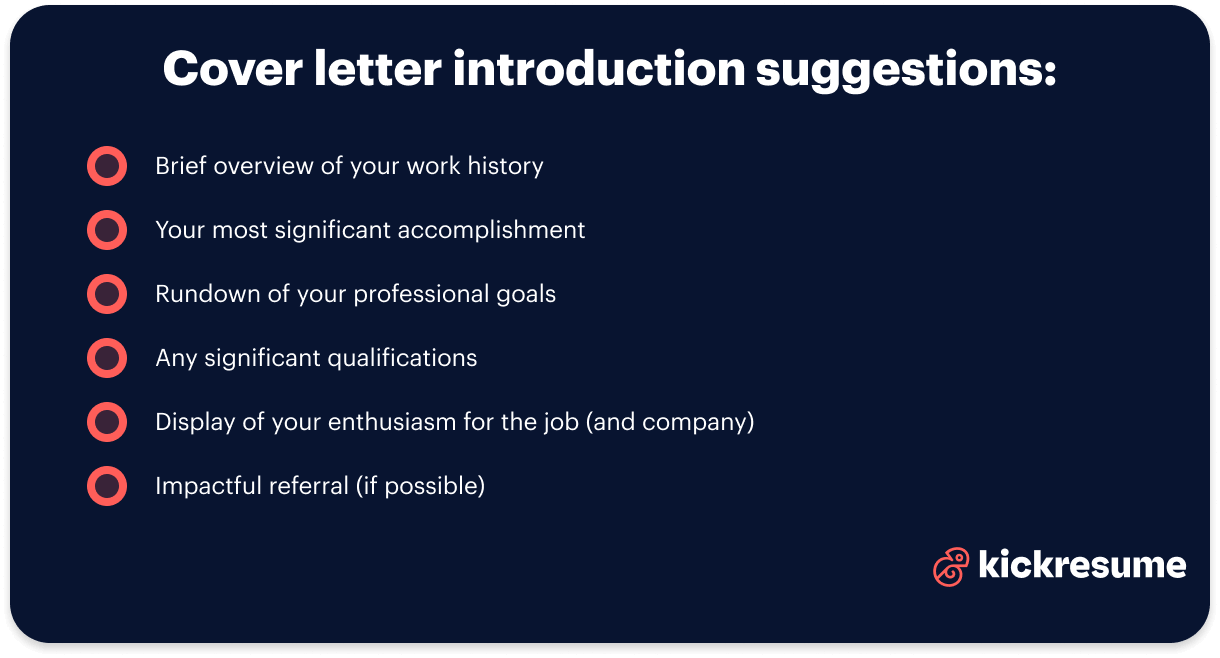
A strong administrative cover letter introduction answers at least one of these questions right away:
- What type of administrative role do you specialize in?
- What kind of experience or results do you bring?
- Why this company or office environment?
- What makes your background relevant to this position?
If your opening paragraph doesn’t establish context or value, it blends in and gets forgotten.
What a weak administrative cover letter introduction looks like
Bad example of a cover letter introduction
I am writing to apply for the administrative assistant position at your company. I have experience in office work and would like the opportunity to be considered for this role.
Why doesn’t this work? It’s polite, but empty. There’s no specificity, no indication of skill level, and nothing that makes this applicant stand out from dozens of others saying the exact same thing.
Strong ways to open an administrative cover letter
There’s no single “correct” formula, but the best introductions lead with something concrete.
Example 1: Introduction with a referral
Maria Novak suggested I apply for the Administrative Assistant position at Greenway Solutions. We worked together for three years, where she saw my role in coordinating office schedules, supporting senior staff, and keeping daily operations running smoothly. I’d welcome the opportunity to bring that same reliability to your team.
Why this works: A referral immediately builds credibility. Someone inside the organization is vouching for the candidate’s work ethic and skills, which lowers perceived hiring risk.
Example 2: Introduction led by accomplishments
Over the past five years, I’ve supported executive teams in fast-paced office environments, managing calendars, coordinating meetings, and improving internal processes that reduced administrative delays by 20%. I’m now looking to bring that efficiency-focused approach to your operations team.
Why this works: This opening leads with experience and results. Even a single measurable improvement makes the candidate feel real and capable.
Example 3: Introduction based on company fit or shared values
Your company’s emphasis on organized workflows and cross-team collaboration immediately caught my attention. In my current administrative role, I support multiple departments and focus on creating systems that help teams communicate and work more efficiently. That alignment is what motivated me to apply.
Why this works: It shows research and alignment without sounding forced. The candidate clearly understands the type of environment they’re applying to.
Example 4: A straightforward but effective introduction
I’m an administrative professional with over four years of experience supporting office operations, coordinating schedules, and handling documentation in corporate settings. In my current role, I manage daily administrative tasks while supporting senior staff and ensuring smooth internal communication. I’m interested in bringing that same structured approach to your team.
Why this still works: It’s not flashy, but it’s clear, specific, and trustworthy. That’s often exactly what administrative hiring managers want.
Tips for entry-level and junior administrative candidates
If you’re new to the field, changing careers, or a student with no experience, focus on what you do have, and not on what you’re missing.
- Internships, traineeships, and office placements matter
- Administrative coursework or certifications are relevant
- Experience with scheduling, data entry, or office tools counts
- Show eagerness to learn without overselling yourself
Entry-level administrative cover letter introduction example
I recently completed an office administration program and gained hands-on experience through an internship, where I assisted with scheduling, document preparation, and front-desk support. I’m eager to continue building my administrative skills in a professional office environment that values organization and reliability.
Whether you’re applying for a junior assistant role or a senior administrative position, your introduction should sound deliberate and grounded. Clear, specific, and purposeful openings are what keep hiring managers reading past the first paragraph.
6. Focus on the skills and achievements that matter most
A strong administrative cover letter doesn’t try to summarize your entire work history. Instead, it highlights the skills and achievements that are most relevant to this role, this office, right now.
That requires intention. You can’t write a convincing cover letter without first reading the job description carefully and responding to what the employer is actually asking for.
Administrative roles vary widely, as some focus on coordination, others on documentation, scheduling, compliance, or executive support. Your goal is to mirror the priorities in the job posting, not list everything you’ve ever done.
How to decide which skills deserve space
The job ad gives you all the signals you need. Pay attention to:
- Repeated requirements: Skills mentioned multiple times are non-negotiable priorities.
- Early placement: Responsibilities listed near the top are often the most important.
- Outcome-driven expectations: Choose skills you can support with examples, improvements, or results, not just descriptions.
If a posting emphasizes calendar management, document control, or internal communication, those should take center stage in your cover letter. Less relevant skills can stay in the background or on your resume.
In-demand skills for administrative roles
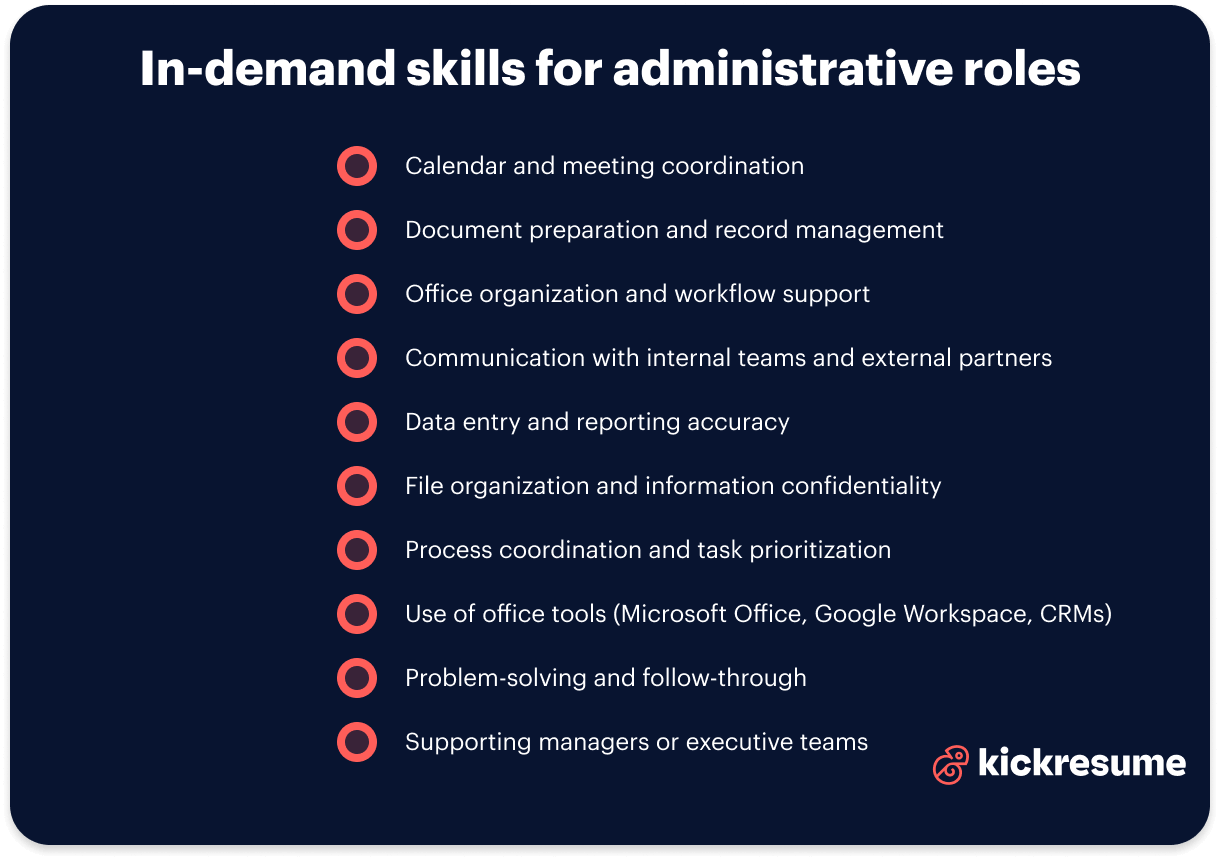
While requirements differ by seniority and industry, these skills appear frequently across administrative job postings:
The 10 most in-demand administrative skills
-
Calendar and meeting coordination
-
Document preparation and record management
-
Office organization and workflow support
-
Communication with internal teams and external partners
-
Data entry and reporting accuracy
-
File organization and information confidentiality
-
Process coordination and task prioritization
-
Use of office tools (Microsoft Office, Google Workspace, CRMs)
-
Supporting managers or executive teams
-
Problem-solving and follow-through
Technical ability matters, but so does soft skills, such as how you communicate, prioritize, and adapt. Administrative professionals often act as the connective tissue of an office, and soft skills play a big role in that.
How to structure the body of your cover letter
To keep this section readable and persuasive:
- Use 2–4 short body paragraphs
- Focus on one key skill or contribution per paragraph
- Add context so the reader understands your role
- Include outcomes or improvements where possible
- Always connect your example back to the job you’re applying for
Context + outcome = credibility
Showing skills and achievements in an administrative cover letter
- Organization and workflow support:
In my current role, I coordinate schedules for three department heads and manage shared calendars, reducing meeting conflicts and last-minute changes by streamlining booking procedures. - Documentation and accuracy:
I’m responsible for preparing and maintaining internal records and reports, ensuring accurate data entry and compliance with company procedures. This helped reduce documentation errors during internal audits. - Communication and coordination:
I regularly serve as the main point of contact between departments, handling inquiries and routing requests efficiently. Clear communication helped improve response times and internal collaboration. - Process investment:
I supported the introduction of a new filing system that improved document retrieval time and made onboarding new team members significantly easier.
What else you can highlight in your cover letter body
Your experience doesn’t have to come only from full-time roles. You can also include:
- Administrative education or coursework
- Certifications or office management training
- Familiarity with specific tools or systems
- Internal projects you supported or improved
- Feedback or trust you earned from supervisors
The key rule is simple: if it doesn’t support your application for this administrative role, leave it out.
Tips for interns and entry-level administrative candidates
If you’re just starting out, focus on responsibility, reliability, and exposure — not seniority.
- Mention internships, traineeships, or temporary office roles
- Highlight tasks you were trusted with
- Show how you supported daily operations
- Reference feedback from supervisors when relevant
Example for an intern or entry-level administrative role
During my internship at BrightPath Solutions, I supported daily office operations by assisting with scheduling, document preparation, and front-desk communication. I was trusted with organizing digital records and supporting internal requests, which helped me understand how structured administrative work keeps teams running smoothly.
Your experience, whether extensive or just beginning, is the backbone of your cover letter. The more clearly you show how your skills and contributions support the role you’re applying for, the easier it is for a hiring manager to picture you in the position.
7. Strengthen your administrative cover letter with action verbs
Word choice has more impact than most candidates realize. In an administrative cover letter, the verbs you use can quietly shape how confident, capable, and professional you sound.
Compare phrases like “I was responsible for” or “I helped with” to sentences that clearly show ownership and results. Action verbs move your writing from passive descriptions to purposeful statements, and that difference stands out fast when recruiters review dozens of applications.
A small change in wording can turn routine tasks into clear contributions.
See the difference action verbs make
Before: I was responsible for organizing office files.
After: I organized and maintained office files to ensure accurate and timely access to records.
Same task. Much stronger impression.
When describing your experience, choose verbs that show initiative, responsibility, and follow-through, as those are all qualities employers expect from administrative professionals.
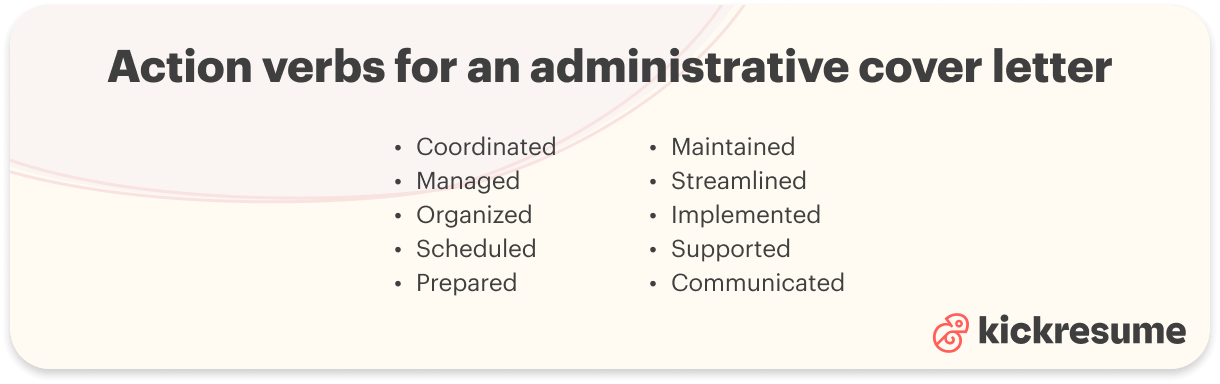
Effective action verbs for administrative cover letters
These verbs work especially well in office and administrative roles:
-
Coordinated
-
Managed
-
Organized
-
Scheduled
-
Prepared
-
Maintained
-
Streamlined
-
Implemented
-
Supported
-
Communicated
Used naturally, these verbs signal that you don’t just “assist”, they showcase that you actively contribute to keeping operations running smoothly.
Quick wording upgrades you can apply immediately
Before: I helped with scheduling meetings.
After: I coordinated meetings and managed calendars to prevent scheduling conflicts.
Before: I worked with internal teams.
After: I collaborated with internal teams to ensure timely communication and task completion.
Before: I was involved in document preparation.
After: I prepared and reviewed documents to ensure accuracy and compliance with company standards.
These changes don’t exaggerate your role, they simply describe it more clearly and confidently.
A quick reminder on balance
You don’t need to force an action verb into every sentence. Overloading your cover letter with overly aggressive language can make it sound stiff or unnatural. Instead, scan your draft for vague phrases and replace them where it makes sense.
Pro tip
Action verbs also help with Applicant Tracking Systems (ATS). Many ATS tools scan for role-specific keywords, and strong verbs paired with relevant skills increase the chances that your cover letter reaches a real recruiter, rather than just a database.
Used thoughtfully, action verbs help your administrative cover letter sound decisive, capable, and professional, which is exactly the impression you want to leave.
8. End your administrative cover letter with confidence
The final paragraph of a cover letter is your last opportunity to leave a lasting impression. You can either reinforce why you’re a strong administrative candidate or quietly disappear at the end of the page.
A strong administrative cover letter conclusion usually includes:
- A brief reminder of your value: One sentence that reconnects your skills or experience to the role.
- A note of interest: Show that you’re genuinely interested in the position and the organization.
- Clear next steps: Make it easy for the employer to contact you.
- A professional sign-off: Polite, confident, and straightforward.
What a weak administrative cover letter closing looks like
Bad example of a cover letter ending
I hope you will consider my application. Please let me know if you need anything else.
Thank you,
Alex
Why does this fall flat? It’s courteous, but forgettable. There’s no reminder of what Alex brings to the role and no sense of confidence or direction. It closes the letter, but it doesn’t add anything.
A stronger way to close an administrative cover letter
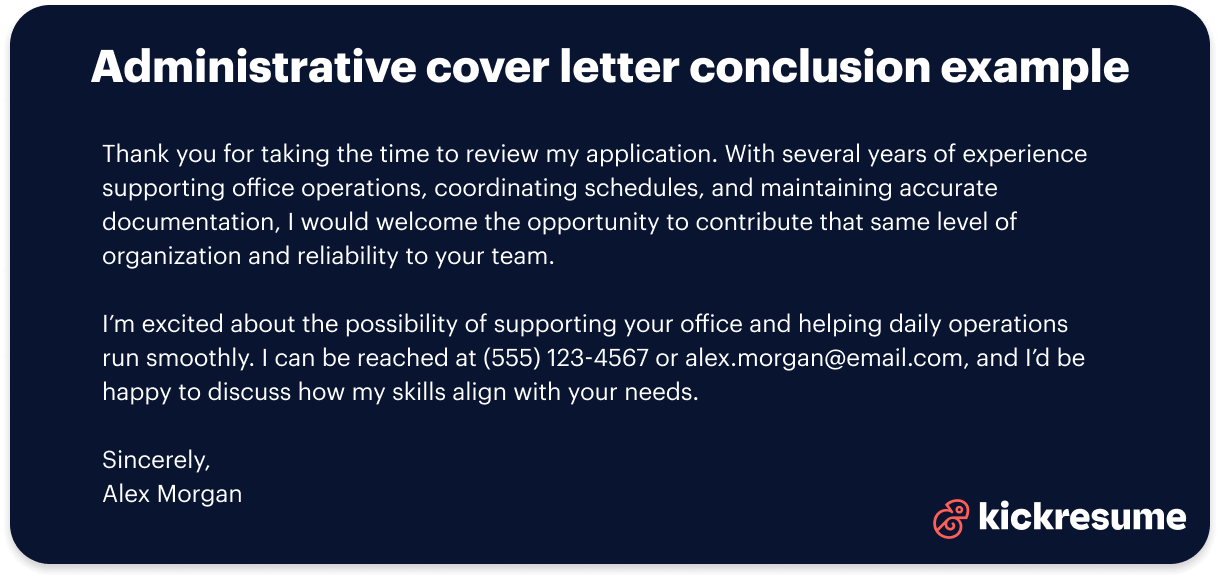
Good example of a cover letter ending
Thank you for taking the time to review my application. With several years of experience supporting office operations, coordinating schedules, and maintaining accurate documentation, I would welcome the opportunity to contribute that same level of organization and reliability to your team.
I’m excited about the possibility of supporting your office and helping daily operations run smoothly. I can be reached at (555) 123-4567 or alex.morgan@email.com, and I’d be happy to discuss how my skills align with your needs.
Sincerely,
Alex Morgan
Why does this work? It reminds the reader who the candidate is, what they offer, and why they’re interested. All without repeating the resume or sounding pushy.
Tips for writing a strong closing paragraph
- Skip empty phrases like “Thank you for your time” unless you add context.
- Keep it concise — 3 to 5 sentences is more than enough.
- Sound confident, not desperate or overly formal.
- Always include clear contact details, even if they appear elsewhere in the letter.
A good closing doesn’t need to be dramatic or overly creative. It just needs to feel intentional and professional. In administrative roles, the strongest endings are clear, calm, and confident, leaving the reader with a solid reason to follow up.
9. Avoid these common mistakes in administrative cover letters
Even with solid administrative experience and the right skill set, small missteps can raise doubts in a hiring manager’s mind, especially in roles where accuracy, organization, and attention to detail are essential.
Below are some of the most frequent mistakes in administrative cover letters and how to avoid them.
-
Mistake #1: Using a generic, reusable cover letter
If your letter could be sent to any company without changes, it probably feels impersonal.
How to fix it: Reference something specific about the role or organization, such as the type of office environment, the department you’d support, or the systems they use. Even one tailored sentence can make your application feel intentional.
-
Mistake #2: Writing too much… or too little
Overly long paragraphs can feel overwhelming, while ultra-short letters lack substance.
How to fix it: Aim for a balanced structure: a clear introduction, 3–4 focused body paragraphs, and a concise conclusion. This gives you enough space to show value without losing the reader.
-
Mistake #3: Focusing only on what you want
A cover letter that talks only about career goals or personal growth misses the point.
How to fix it: Shift the focus to how you support the office. Highlight how your skills help keep operations organized, communication clear, or workflows efficient, ideally with real examples.
-
Mistake #4: Repeating your resume word for word
Your resume already lists your tasks and job titles. Copying it into paragraph form adds no new value.
How to fix it: Use the cover letter to explain how you worked, what you improved, and why your approach mattered. Context and outcomes make your experience more convincing.
-
Mistake #5: Overlooking instructions in the job posting
Administrative roles often require following procedures and employers notice when instructions are ignored.
How to fix it: If the posting asks for a specific subject line, document format, reference number, or attachment, follow it exactly. It’s a simple way to demonstrate reliability.
-
Mistake #6: Typos and unclear phrasing
Even minor errors can suggest carelessness. That is something employers try to avoid in administrative hires.
How to fix it: Proofread carefully. Read your letter aloud, use spell-check tools, and if possible, ask someone else to review it before sending.
-
Mistake #7: Poor formatting and layout
A cluttered or hard-to-read cover letter can lose attention instantly.
How to fix it: Use a clean font, short paragraphs, consistent spacing, and clear alignment. White space is your ally, as it makes your letter easier to scan and more professional.
-
Mistake #8: Being vague about your contributions
Saying you “supported the office” or “handled administrative tasks” doesn’t show impact.
How to fix it: Whenever possible, be specific. Mention improvements like smoother scheduling, fewer errors, better communication flow, or time saved through organization.
All of these adjustments may feel small, but together they make a big difference. Administrative roles depend on precision and clarity, and those are exactly the qualities your cover letter should reflect. Take a final pass before submitting, and don’t let avoidable mistakes undermine an otherwise strong application.
10. Make your administrative cover letter and resume work together
A strong job application isn’t built on a single document. Your cover letter and administrative resume serve different purposes, but they should always complement each other.
Think of it this way:
- Resume: structured facts - job titles, responsibilities, timelines, tools, and qualifications
- Cover letter: context - how you work, how you support teams, and why you’re a good fit
- Together: a complete picture - one shows capability, the other shows approach and professionalism
When these two documents align, your application feels intentional and well-prepared.
How to create a consistent application set
You don’t need advanced design skills to make your documents look cohesive. Just pay attention to a few details:
- Matching contact details: Use the same name format, phone number, email address, and LinkedIn link on both documents.
- Consistent font choice: If your resume uses a clean font like Arial or Calibri, keep your cover letter aligned.
- Aligned layout and spacing: Similar margins, line spacing, and text alignment help your documents feel connected.
- Subtle formatting echoes: Reuse simple elements like bold section titles or spacing patterns to create visual harmony.
- Careful use of color: If you use a small accent color in your resume, carry it over lightly into your cover letter, but keep it minimal, so your documents are both scannable and readable easily.
These details might seem small, but together they signal organization and attention to detail, both of which are essential in administrative roles.
When templates make sense
If formatting isn’t your strength or you want to save time, our functional and good-looking cover letter templates and resume templates can be a great solution. Using a matching resume and cover letter template ensures your documents look consistent without extra effort.
When your resume and cover letter feel like they belong together, your application feels more polished, professional, and easier to trust.
Try our AI Resume Writer and have your resume ready in minutes!

11. Average salary and job outlook for administrative roles
Administrative positions form the backbone of many organizations — from small offices to large corporations. Because of that, demand for reliable administrative professionals remains steady across industries.
Salary expectations
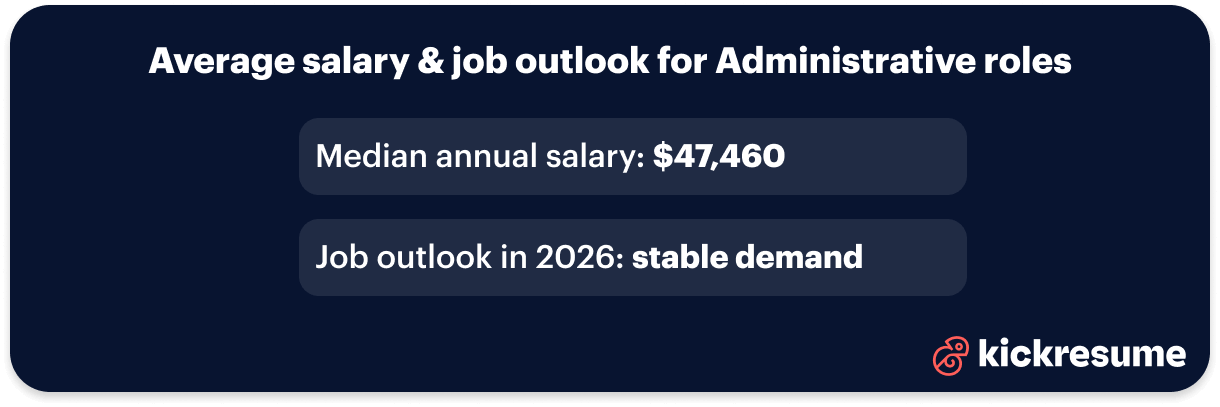
The U.S. Bureau of Labor Statistics reports that the median annual wage for secretaries and administrative assistants was $47,460 in May 2024. That median means half earned more and half earned less, and it includes a wide range of administrative roles, from entry-level office assistants to experienced executive support professionals.
To put that into perspective:
- Entry-level administrative roles often start in the low-to-mid $30,000s
- Mid-level administrative professionals commonly earn $45,000–$55,000
- Senior or specialized administrative roles (executive assistants, office managers, service administrators) can reach $60,000+, especially in larger organizations or high-cost locations
These figures vary widely, but they show that administrative careers offer clear earning progression as experience grows.
What influences administrative salaries?
Several factors play a major role in how much an administrative professional can earn:
- Location: Salaries are typically higher in large cities and high-cost regions
- Experience level: Years of experience and scope of responsibility matter a lot
- Industry: Legal, medical, finance, and tech offices often pay more
- Technical skills: Proficiency with software, CRM systems, ERP tools, or advanced spreadsheets can boost pay
- Level of responsibility: Supporting executives or managing office operations usually comes with higher compensation
In administrative roles, reliability and efficiency often translate directly into career advancement and better pay over time.
Job outlook for administrative professionals
Administrative positions continue to show stable demand, even as workplaces evolve. While some routine tasks are becoming automated, companies still rely heavily on skilled professionals to coordinate people, processes, and communication.
The BLS projects that employment in office and administrative support roles will remain strong over the coming years, with ongoing openings driven by employee turnover, retirements, and organizational growth.
Is administration a secure career path?
For many people, yes, especially if you build adaptable skills.
- Stability: Administrative roles exist in nearly every industry
- Low automation risk: While software can assist with tasks, it can’t fully replace human judgment, coordination, and communication
- Growth potential: Many professionals move from junior admin roles into office management, executive assistance, operations, or HR support
- Predictable schedules: Many administrative roles offer regular hours and structured workweeks
That said, administrative careers reward those who continue learning mostly in areas like digital tools, process optimization, and communication systems.
If you enjoy organization, problem-solving, and being the person who keeps things running smoothly behind the scenes, administrative roles can offer both stability and long-term career growth.
12. Useful resources for job-seeking administrative professionals
Looking for an administrative role doesn’t have to be a guessing game. With the right mix of job boards, networking, and learning platforms, you can uncover opportunities faster and position yourself as a strong candidate.
Below are some reliable resources worth keeping on your radar.
Industry-focused job boards:
While many administrative roles appear on general job boards, some platforms specialize in office and support positions. Websites like iHire or Robert Half focus heavily on administrative, clerical, and office-based roles, including temporary and permanent placements.
General job search websites:
You shouldn’t skip the big players. Platforms such as Indeed, Glassdoor, and ZipRecruiter list thousands of administrative roles every day. Use keywords like administrative assistant, office administrator, service administrator, or executive assistant to narrow your search.
Staffing agencies and recruiters:
Many administrative jobs are filled through recruitment agencies before they ever reach job boards. Agencies such as Robert Half, Adecco, or Kelly Services specialize in office and administrative placements and can help match your experience with suitable employers.
Professional networking platforms:
LinkedIn is one of the most powerful tools for administrative job seekers. Follow companies you’re interested in, connect with office managers or HR professionals, and set job alerts for specific administrative titles. Many administrative roles are shared directly on LinkedIn before being posted elsewhere.
Learning and upskilling platforms:
Strengthening your administrative skill set can significantly improve your chances. Platforms like Coursera and edX offer courses in office productivity, communication, project coordination, and business software that are highly relevant to administrative roles.
Local networks and referrals:
Administrative hiring still relies heavily on trust and recommendations. Let former colleagues, supervisors, or contacts know you’re looking. Even a short referral can help your application stand out in a competitive pool.
Company career pages:
Many organizations advertise administrative roles directly on their websites before posting them elsewhere. If you have target employers in mind (corporate offices, healthcare providers, law firms, schools), check their careers pages regularly.
Local networks and referrals:
Administrative hiring still relies heavily on trust and recommendations:
- Ask former colleagues or supervisors for referrals
- Join local professional groups or office management communities
- Let your network know you’re open to administrative opportunities
Even a short recommendation can move your application to the top of the pile.
Job searching is rarely instant, but consistency pays off. Combine a polished administrative cover letter with a targeted resume and smart use of these resources, and you’ll greatly improve your chances of landing the right role.
Administrative Career Outlook in 2026
Administrative jobs are expected to grow by 4% between now and 2034. That’s faster than the nationwide average for all occupations. (Source: U.S. Bureau of Labor Statistics).
And with roughly 36,400 openings expected each year, most opportunities will come from replacement needs as people retire or move on.
At the same time, AI is absorbing the repetitive parts of admin work like scheduling, document prep, and basic reporting, which means the job is shifting toward coordination, problem-solving, and tool-savvy support rather than disappearing.
Average US base salaries across popular Administrative roles:
- Administrative Clerk: $46,580/year
- Facilities Manager: $82,932/year
- Front Desk Receptionist: $35,838/year
- Office Manager: $66,715/year
- Personal Assistant: $52,908/year
These salary estimates come from Indeed (as of January 2026), and are based on anonymous submissions from workers, along with salary data from job postings on the platform over the last 36 months.
As you can see, salaries can vary significantly across roles in this field, based on location, company size or experience level. If you’re considering a career in administration, be sure to explore and compare your options carefully.
Administrative Cover Letter FAQ
Should I customize my administrative cover letter for every job?
Yes, and it makes a real difference. Reference the company by name, mention the type of office environment, and align your skills with the job description. Even small customizations show attention to detail, which is crucial in administrative roles.
You can use Kickresume’s AI Cover Letter Writer to help you tailor your document quickly and effortlessly.
Can an administrative cover letter really make a difference?
Absolutely. A great cover letter that compliments a strong resume makes a powerful job application. Administrative roles often attract many applicants with similar resumes. A well-written cover letter helps you stand out by showing professionalism, reliability, and how you approach your work, as those are things that aren’t always obvious from a resume alone.
Kickresume’s resume and cover letter building tools can help you create both documents you need to successfully land a job.
What should I include in an administrative cover letter?
Keep your cover letter focused. Include a short introduction, your most relevant experience or skills, the tools or systems you’ve worked with, and a confident closing. Emphasize organization, communication, and how you support smooth daily operations.
How long should an administrative cover letter be?
The length of a cover letter is pretty simple - one page is the rule. Aim for 3–5 short body paragraphs that are easy to scan. Administrative roles value clarity and structure, so if your cover letter feels long or crowded, it probably is.
How do I write a strong administrative cover letter with no experience?
Focus on transferable skills. Organization, communication, time management, and attention to detail all matter in administrative roles. Internships, part-time office work, volunteering, school projects, or customer-facing roles can all be relevant. Use your cover letter to show that you’re reliable, organized, and quick to learn, as that’s what employers look for at entry level.
You can read our thorough guide on How to create a cover letter with no experience for more details.
Do I need formal education or certifications for an administrative cover letter?
Not always. Many administrative roles don’t require a degree, but relevant education or training can help. Courses in office administration, business communication, or software tools (like Microsoft Office or Google Workspace) are often valued. If you have certifications or training in progress, mention them.
Here’s a full guide on how to write a cover letter that gets you results.
What skills matter most in an administrative cover letter?
Employers look for a mix of technical and soft skills. Highlight things like scheduling, document management, communication, time management, and accuracy. If possible, mention tools you’ve used (calendars, spreadsheets, CRM systems) and how they helped improve efficiency.








![Coop Project Manager Cover Letter Sample [SV]](https://d1xn1bcogdo8ve.cloudfront.net/231/thumbnail.webp)


![Analyst at ING Cover Letter Sample [ES]](https://d1xn1bcogdo8ve.cloudfront.net/2969/thumbnail.webp)




![Representante de ventas en Adidas currículum ejemplo [ES]](https://d1xn1bcogdo8ve.cloudfront.net/472/thumbnail.webp)